Wondering why one Paradise Valley estate commands a premium while another, with similar square footage, sits longer or trades lower? In this market, value is rarely about size alone. If you own, plan to buy, or are considering a future sale in Paradise Valley, understanding what truly drives pricing can help you make smarter decisions. Let’s dive in.
Land sets the foundation
In Paradise Valley, land is often the biggest value driver. The town’s planning framework is built around low-density, semi-rural residential development, and most of the community is zoned for at least one acre per lot. That means parcel size, zoning category, and the amount of usable land all carry real weight with buyers.
Not all acres are equal, though. A lot with a better building pad, more practical dimensions, and fewer site constraints can be far more valuable than a larger but harder-to-use parcel. In a high-end market like Paradise Valley, buyers often start by asking what the land allows, not just what the current home looks like.
Buildable envelope matters
What can actually be built on a site affects value just as much as lot size. Paradise Valley’s flatland residential guidance sets maximum house heights at 24 feet for lots under 3 acres, 26 feet for lots between 3 and 4 acres, and 30 feet for lots 4 acres and larger.
Setbacks, grading considerations, drainage, and hillside review can also shape a property’s future potential. If a site offers a cleaner path for a remodel, addition, or new build, that can make it more attractive than a similar property with more limitations.
Zoning can change the buyer pool
Most of Paradise Valley is zoned R-43, but the town also includes other districts such as R-175, R-35, R-18, and R-10. For buyers, that zoning context can influence both immediate use and long-term flexibility.
For sellers, this is important because pricing is often tied to what a sophisticated buyer sees as possible on the lot. In luxury markets, future optionality can support value just as strongly as the home’s current finish level.
Views and privacy drive premiums
In Paradise Valley, views are not just a lifestyle perk. They are a meaningful pricing factor. The town’s general plan specifically emphasizes preserving scenic resources like mountain ridgelines, scenic views, and dark night skies, which tells you how central these features are to the community’s identity.
That matters because buyers in this market often pay more for what cannot be recreated later. A protected mountain view, a long sightline, or a naturally buffered homesite can elevate a property into a different pricing tier.
Open space adds scarcity
The town’s Mountain Preserve Trust exists to preserve natural landscape, desert plants, wildlife, and scenic beauty. Since no general access or use is permitted on that trust land except for police and public utility functions, nearby properties can benefit from a more permanent open-space setting.
That kind of backdrop is hard to duplicate. Homes close to preserved land or with uninterrupted outlooks often stand apart from otherwise similar homes nearby.
Privacy has measurable appeal
Paradise Valley’s official planning documents place clear value on privacy, quiet, and open space. Buyers are often drawn to homes that feel tucked away, protected, and well-positioned within the desert landscape.
This can show up in several ways, including lot orientation, setbacks, landscaping, and the relationship to surrounding properties. Even within the same area, one home may feel substantially more private than another, and that difference can influence demand.
Architecture affects perceived value
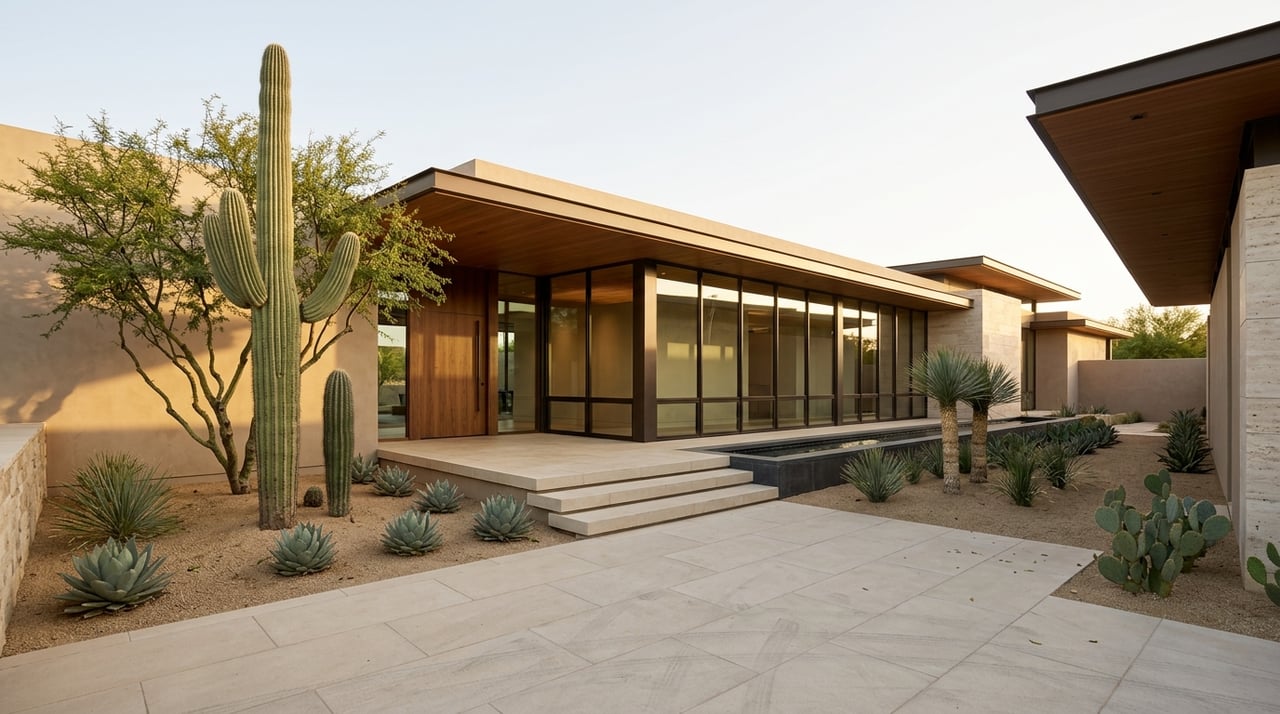
In a market like Paradise Valley, buyers are not just purchasing square footage. They are buying how well a home fits its setting. The town’s general plan calls for a high-quality built environment that reflects the area’s historical, environmental, and architectural context.
That means design quality matters. A home that feels cohesive, well-sited, and visually appropriate to its lot often creates stronger emotional appeal and better pricing support than one that feels oversized for the site or disconnected from its surroundings.
Condition still matters at the top end
Luxury buyers may appreciate architecture, but they also notice condition immediately. In a selective market, deferred maintenance, dated finishes, or exterior spaces that do not match the caliber of the home can hold value back.
On the other hand, a residence that presents as polished and intentional tends to perform better. This is especially true when the design, materials, and outdoor spaces feel integrated rather than pieced together over time.
Outdoor living supports value
Paradise Valley averages 294 days of sunshine per year, and that climate shapes buyer expectations. Outdoor living is not a bonus feature here. It is part of how people expect to use the home.
Covered patios, pools, shaded seating areas, and strong indoor-outdoor flow can all strengthen a property’s appeal. Homes that make the lot feel usable and connected to the desert setting often align more naturally with the local lifestyle.
Location within Paradise Valley matters
One of the biggest misconceptions about Paradise Valley real estate is that the entire town moves as one market. In reality, values can vary widely based on exact location, surrounding uses, nearby views, and the character of neighboring development.
This is one reason broad price-per-square-foot comparisons can be misleading. A property’s street, its immediate setting, and its relationship to nearby open space or resorts can all shape value.
Micro-markets create pricing gaps
Neighborhood-level data shows meaningful price spreads within Paradise Valley. Realtor.com reported a median listing price of $2.737 million in Mountain Shadow Resort and $5.45 million in Paradise Hills.
That spread is a useful reminder that Paradise Valley is highly pocket-specific. Two homes in the same town can attract very different buyer expectations depending on their immediate context.
Amenity context can support demand
Paradise Valley offers more than large lots and mountain views. The town identifies 9 resorts, 3 golf courses, 11 public and private schools, and 4 medical centers, and its planning documents describe it as a high-quality resort destination within the Phoenix metro area.
For some buyers, that wider lifestyle package helps justify pricing. Proximity to resorts, golf, and everyday services can add convenience and appeal, especially for second-home owners and relocating buyers.
Current market conditions shape negotiations
Even in an estate market, timing and conditions still matter. Recent data points to an active but not overheated environment. Redfin reported a median sale price of $4.62 million over the three months ending April 2026, with homes averaging 69 days on market.
Realtor.com reported a March 2026 median listing price of $4.99 million, 372 active listings, a 95% sale-to-list ratio, and homes selling for about 5.0% below asking on average. In plain terms, buyers are active, but they are selective.
Buyers focus on what cannot be changed
In a more balanced high-end market, the strongest pricing usually goes to homes with the most irreplaceable attributes. Think lot quality, privacy, protected views, and a home that fits the site well.
Features that are easier to update, like some finishes or decor choices, tend to carry less weight than the land and setting. That is why two estates with similar interiors can perform very differently once they hit the market.
A practical value hierarchy for sellers
If you are preparing to sell a Paradise Valley estate, it helps to think about value in layers. Based on the local planning context and current market behavior, the hierarchy often looks like this:
- Irreplaceable site attributes such as views, privacy, and lot quality
- Buildable envelope and ease of future improvements
- Architectural quality and fit with the setting
- Outdoor livability and amenity context
- Current market conditions and buyer timing
When a property checks the first few boxes well, it is usually in a stronger position to defend price. When those elements are missing, marketing alone cannot fully bridge the gap.
Why local guidance matters
Because Paradise Valley values are shaped by land, planning rules, view corridors, and hyper-local differences, accurate pricing takes more than a quick online estimate. It requires a close read of the lot, the setting, the home’s design, and the current buyer pool.
That is where tailored, neighborhood-specific advice becomes valuable. Whether you are deciding when to sell, how to position an estate, or what improvements may actually move the needle, a detailed local strategy can help you protect value and make confident decisions.
If you want a clear, discreet opinion on what is driving your property’s value in today’s market, connect with Fine Homes Group for a complimentary home valuation or a white-glove consultation.
FAQs
What most affects Paradise Valley estate values?
- The biggest factors are usually lot quality, usable land, privacy, scenic views, buildable envelope, architectural fit, outdoor livability, and exact location within Paradise Valley.
How important is lot size in Paradise Valley home values?
- Lot size is very important because Paradise Valley is largely built around low-density residential development with many one-acre lots, but usable land and site constraints matter just as much as raw acreage.
Do mountain views increase Paradise Valley property value?
- Yes, mountain views and protected view corridors often support higher value because they are scarce, hard to replicate, and closely tied to the town’s planning priorities and buyer expectations.
Why do Paradise Valley home prices vary so much by area?
- Prices can vary significantly because Paradise Valley is a collection of micro-markets where street location, nearby open space, surrounding development, and local view orientation can change buyer demand.
Does architecture matter in Paradise Valley resale value?
- Yes, design quality matters because buyers often look for homes that fit the desert setting, feel cohesive on the lot, and offer a strong relationship between indoor and outdoor living.
Is Paradise Valley a seller’s market in 2026?
- Current data suggests an active but not overheated market, with buyers remaining selective and homes often selling close to, but still below, asking price on average.